
Scorpio BMH · Manufacturers Since 1984

Pneumatic Conveying System Manufacturer for Powder & Bulk Material Handling

The definitive guide to understanding, selecting, and optimising pneumatic conveying systems for industrial powder and bulk material handling written by engineers, for engineers.

40+                                  2700+                       1226+ 
Years Experience          System Installed       Happy Clients

What Is a Pneumatic Conveying System?

A pneumatic conveying system is an enclosed material transport solution that moves dry bulk powders, granules, and pellets through pipelines using a pressurised or vacuum gas stream almost always air generated by a blower or compressor.

Unlike mechanical conveyors (screw conveyors, belt conveyors, bucket elevators), pneumatic systems have no moving parts along the conveying pipeline. Material flows inside sealed pipes, making the process dust-free, hygienic, and fully automatable.

These systems are widely used across cement, food, pharmaceuticals, chemicals, plastics, glass, and dozens of other industries that handle powdered or granular raw materials.

Definition

Pneumatic Conveying System
 — a closed-loop pipeline installation that uses a differential air pressure (positive pressure or vacuum) to entrain, transport, and separate bulk solid particles from an air stream, discharging material at one or more destinations without any mechanical conveying element along the transfer pipeline.

Scorpio Engineering BMH has been designing and manufacturing pneumatic conveying systems since 1984, delivering more than 2,700 installations across India, South Asia, and internationally  for clients including BASF, Cadbury, Asahi Glass, Air Liquide, and Bhabha Atomic Research Centre.

How Does a Pneumatic Conveying System Work?

All pneumatic conveying systems follow the same fundamental process: a pressure differential is created across pipeline, material is introduced into the airstream, transported, and then separated at the destination.

The 5-Step Process

1. Air Mover
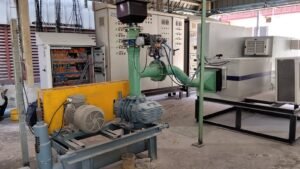
 A blower, roots blower, or compressor generates the required air pressure or vacuum to drive the airstream through the pipeline.

2. Material Feed 
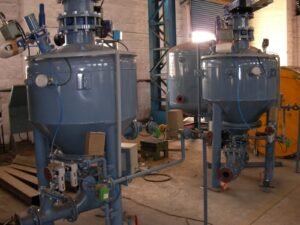
Material enters the pipeline via a rotary airlock valve (dilute phase) or a pressure vessel / powder pump (dense phase) at the pick-up point.

3. Conveying 
The air-material mixture flows through the sealed pipeline. Velocity, pressure ratio, and pipe diameter determine the conveying mode and efficiency.

4. Separation 
Material is separated from the airstream in a receiver vessel, silo, or hopper by cyclonic action, gravity, or a filter receiver at the destination.

5. Air Filtration 
The exhaust air passes through a pulse-jet filter or bin vent filter to capture fine particles before being safely released to atmosphere

Positive Pressure SystemsVacuum (Negative Pressure) Systems
Air is blown into the pipeline from the feed end. Material is pushed toward the discharge point. Suited for conveying to multiple destinations from a single feed point. Pressure typically 0.5–4 bar (g).Suction is applied at the discharge end, pulling material from the feed point. Ideal for unloading bulk tankers, hoppers, or multiple pick-up points to a single destination. Vacuum typically −0.3 to −0.8 bar.

Types of Pneumatic Conveying Systems

1. Dense Phase Pneumatic Conveying

Dense phase conveying moves material at low velocity and high pressure through the pipeline in a moving bed, slug, or plug flow pattern. The material-to-air ratio is very high  making it exceptionally gentle on fragile or abrasive powders.

Velocity1 – 5 m/s
Pressure0.5 – 4 bar (g)
Solids Loading Ratio20 – 150+
Ideal ForFragile, abrasive, cohesive powders
Typical DistanceUp to 1,500 m
Air ConsumptionLow

2. Dilute Phase Pneumatic Conveying

Also called lean phase or suspension flow, this method suspends particles uniformly in a high-velocity airstream at lower pressure. It is the most common conveying mode cost-effective and versatile for free-flowing, non-abrasive materials.


Velocity15 – 35 m/s
Pressure0.05 – 1 bar (g)
Solids Loading Ratio1 – 15
Ideal ForFree-flowing, light powders
Typical DistanceUp to 300 m
Air ConsumptionHigher
Dense Phase Pneumatic Conveying
Lean-dilute phase system

Not sure which type suits your application? Scorpio BMH’s engineers conduct free feasibility studies to evaluate your material’s bulk density, particle size, moisture content, abrasivity, and required throughput and recommend the most energy-efficient system design.

Key Components of a Pneumatic Conveying System

A complete pneumatic conveying installation integrates several engineered sub-systems. Each component must be correctly sized and selected to ensure reliable, energy-efficient operation.


ComponentFunction
Air Mover (Blower / Compressor)Generates the pressure differential that drives material through the pipeline. Roots blowers for dilute phase; screw compressors or reciprocating compressors for dense phase.
Pressure Vessel / Powder PumpIntroduces material into the high-pressure pipeline in dense phase systems. Operates in timed fill-and-blow cycles. Scorpio's RSTAR-enabled vessels include automated diagnostics.
Rotary Airlock ValveMeters material into the conveying pipeline in dilute phase systems while maintaining the pressure seal between atmosphere and the pipeline.
Conveying Pipeline & BendsThe enclosed transport pathway. Pipe diameter, bend geometry, and material determine pressure drop and system sizing. Long-radius bends reduce wear and material degradation.
Diverter ValvesRoute material to multiple discharge points from a single pipeline. Available as twin-outlet, multiway, or heavy-duty configurations.
Slide Gates & Sweep ValvesIsolation and control valves used at feed points, divert stations, and discharge outlets.
Receiver Vessel / Silo / HopperCollects discharged material at the destination. Sized based on throughput and storage requirements. Equipped with bin activators or air pads to prevent bridging.
Filter Receiver / Dust CollectorSeparates residual fine material from exhaust air before release to atmosphere. Pulse-jet cleaning maintains continuous filtration efficiency.
Control System (PLC/SCADA)Automates cycle timing, pressure monitoring, alarm management, and data logging. Scorpio's RSTAR platform adds remote monitoring and fault diagnostics.
Silo Relief ValveSafety device that protects storage silos from over-pressure during filling operations.

Dense Phase vs Dilute Phase: Full Comparison

Use this comparison matrix to identify which conveying mode aligns with your process requirements, material characteristics, and operational priorities.


ParameterDense Phase ConveyingDilute Phase Conveying
Conveying Velocity1 – 5 m/s (very low)15 – 35 m/s (high)
Operating Pressure0.5 – 4 bar (g)0.05 – 1 bar (g)
Air ConsumptionLowHigher
Material DegradationMinimalModerate
Pipeline WearLowModerate – High
Fragile MaterialsExcellentNot recommended
Abrasive MaterialsSuitableCauses rapid wear
Maximum DistanceUp to 1,500 mUp to 300 m
Throughput Capacity1 – 100+ tph1 – 50 tph
Capital CostHigherLower
Energy EfficiencyHigh (less air)Moderate
Best ForCement, fly ash, alumina, carbon black, plastic pelletsSugar, flour, soda ash, plastic powder, light minerals
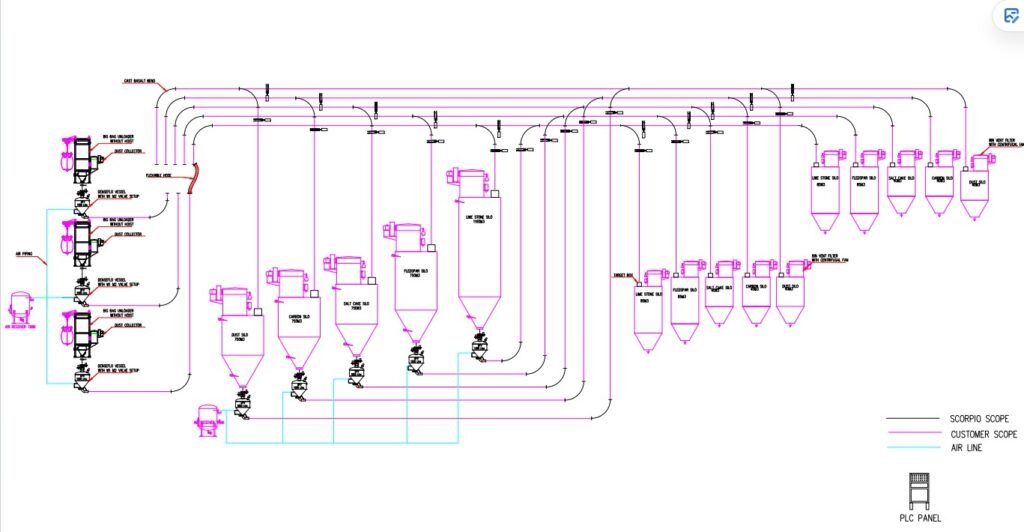
Dense Phase Flow Chart Process
Dense Phase Flow Process
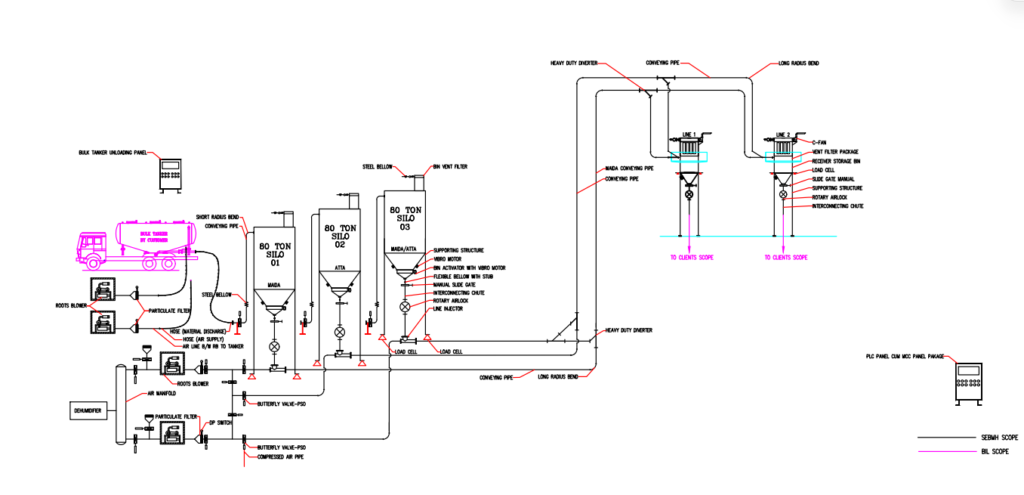
Dilute(lean) phase system
Dilute Phase Flow Process

Industries Served by Pneumatic Conveying Systems

Pneumatic conveying systems are trusted across virtually every industry that handles dry bulk materials. Scorpio BMH has delivered proven solutions across all of the following sectors.

Cement & Fly Ash

Dense phase conveying of cement, fly ash, raw meal, and clinker dust for silos and blending systems.

Chemicals

Soda ash, titanium dioxide, carbon black, silica, sulphur, and specialty chemical powders.

Food & Beverage

Sugar, flour, starch, salt, cocoa, milk powder, and spices in hygienic, SS304 mirror-finish systems.

Pharmaceuticals

API powders, excipients, and active ingredients with GMP-compliant, fully enclosed conveying.

Paints & Pigments

Titanium dioxide, iron oxides, calcium carbonate, and specialty pigment powders.

Glass & Ceramics

Batch raw materials – silica sand, soda ash, feldspar, dolomite  for float glass and ceramic plants.

Minerals & Metals

Alumina, bauxite, copper concentrate, metal powders, and mineral sands.

Petrochemicals

Plastic pellets, polyethylene, polypropylene, PVC powder, and catalyst materials.

Soaps & Detergents

Detergent powder, spray-dried surfactants, and sodium tripolyphosphate (STPP).

Powders & Materials Conveyed Pneumatically

Pneumatic conveying handles an enormous variety of dry bulk materials. Below is a representative list of materials Scorpio BMH systems have successfully conveyed.

Portland CementFly AshLimestone PowderCarbon BlackAluminaSilica SandTitanium DioxideSoda AshSodium BicarbonateSugarWheat FlourStarchSalt (NaCl)Cocoa PowderMilk PowderPlastic Pellets (PE, PP, PVC)Polyethylene PowderKaolinCalcium CarbonateBauxiteCopper ConcentrateIron Ore FinesPerliteDiatomaceous EarthPhosphate RockSTPP (Detergent)Sulphur PowderActivated CarbonZeoliteGlass BatchIron Oxide PigmentAPI Pharmaceutical PowdersCoal DustPet Coke

Not sure if your material can be conveyed pneumatically? Scorpio BMH can perform a material test and feasibility study  including bulk density measurement, particle size analysis, flowability assessment, and pilot-scale conveying trials before system design begins.

Advantages of Pneumatic Conveying Systems

Compared to mechanical conveying alternatives, pneumatic systems offer compelling operational, environmental, and economic benefits.

Fully Enclosed & Dust-Free

Material travels inside sealed pipelines  eliminating dust emissions, product loss, contamination, and housekeeping costs. Critical for food, pharma, and hazardous materials.


Compact Footprint

Pipelines occupy minimal floor space, run overhead or underground, and eliminate the wide access corridors required for belt conveyors and bucket elevators.

Flexible Routing

Pipelines can run horizontally, vertically, and around obstacles. A single pipe can convey to multiple destinations using diverter valves  impossible with belt or screw conveyors.


Fully Automatable

PLC/SCADA integration enables fully automated, unattended operation with remote monitoring, alarm management, and performance data logging via Scorpio’s RSTAR platform.

Low Maintenance

No moving parts along the conveying line means minimal wear components, fewer maintenance stoppages, and dramatically lower lifecycle costs versus mechanical conveyors.


Hygienic Design

SS304 mirror-finish pipelines, TÜV-certified components, and CIP-compatible designs meet the strictest food, dairy, and pharmaceutical hygiene standards.

Energy Efficient

Dense phase systems consume up to 25% less energy than equivalent mechanical systems. Scorpio’s optimised designs further reduce air consumption and operating costs.


Long-Distance Transport

Dense phase systems can convey material over distances exceeding 1,500 metres — connecting remote storage silos, batching stations, and process equipment across large plants.

Impact of Using a Pneumatic Conveying System

Switching to pneumatic conveying delivers measurable, plant-wide improvements  from the factory floor to the balance sheet. Here is the documented impact across operations that have made the transition.

90Reduction in Dust Emissions
 
25Lower Energy Consumption
 
60Fewer Maintenance Stoppages
 
3× Higher Throughput Reliability

🏭

Operational Uptime

Mechanical conveyors — screw, belt, bucket elevator — are plagued by bearing failures, belt tears, and blockages. Pneumatic systems have no moving parts along the pipeline, reducing unplanned downtime by up to 60%. Plants report shift-level OEE improvements of 8–15 percentage points after switching.

↑ 60% fewer stoppages ↑ Higher OEE

💰

Operating Cost Reduction

Lower energy draw (especially dense phase), elimination of spillage and product loss, reduced housekeeping labour, and fewer spare parts collectively cut the total cost of material transfer by 20–35% versus equivalent mechanical conveying installations over a 5-year period.

↓ 25% energy use ↓ 30% lower OpEx

🌫️

Dust & Environmental Control

Open mechanical conveyors release fine particles into the plant atmosphere — a health hazard, explosion risk, and regulatory liability. Fully enclosed pneumatic pipelines slash airborne dust by up to 90%, directly improving air quality compliance, worker safety records, and ESG reporting metrics.

↓ 90% dust emissions ✔ Regulatory compliance

🧑‍🔬

Product Quality & Purity

Sealed conveying prevents cross-contamination and moisture ingress. For food, pharma, and specialty chemical applications, this translates directly to fewer batch rejections, improved yield, and consistent product specifications — protecting brand reputation and reducing waste disposal costs.

↓ Fewer rejections ↑ Yield consistency

👷

Workforce & Safety

Eliminating open material transfer points removes the leading causes of industrial injury in bulk handling: manual shovelling of spillage, exposure to hazardous dust, and entanglement with moving mechanical parts. LTIFR (Lost Time Injury Frequency Rate) improvements of 40–70% have been documented post-conversion.

↓ LTIFR by 40–70% ✔ ATEX compliance

📐

Plant Layout & Expansion

Pipelines route overhead, underground, and around obstacles  freeing valuable floor space that mechanical conveyors previously monopolised. This unlocks plant capacity expansions without civil construction, and enables multi-floor or cross-building material transfer that would otherwise require major structural changes.

↑ Floor space freed ↑ Expansion flexibility

📊

Data & Process Visibility

Modern pneumatic systems especially those running Scorpio’s RSTAR platform – generate continuous operational data: pressure, flow rate, cycle time, and energy consumption. This data feeds into MES and SCADA systems, enabling predictive maintenance, batch traceability, and real-time throughput optimisation.

✔ Predictive maintenance ✔ SCADA integration

🌱

Sustainability & ESG Goals

Lower energy consumption, near-zero material spillage, reduced cleaning water usage, and dramatically lower dust emissions all contribute to measurable improvements in a plant’s carbon and environmental footprint. For companies with Scope 1 & 2 reduction targets, pneumatic conveying is one of the highest-impact infrastructure upgrades available.

↓ Carbon footprint ✔ ESG reporting


“We have completed all commissioning trials and multiple production batches, and are satisfied with the plant’s operability and quality. We thank Scorpio Engineering for their design and construction, considering the contract fulfilled and the plant complete.”

— Steve Dyball, Regional Operations Manager, BASF

How to Choose the Right Pneumatic Conveying System

Selecting a pneumatic conveying system is an engineering decision that balances material properties, process requirements, and total cost of ownership. Follow these steps to scope your system correctly.

1. Characterise Your Material

Determine bulk density (kg/m³), particle size distribution (µm), particle shape, moisture content (%), flowability (Jenike flow factor), abrasivity index, and whether the material is fragile or hazardous. These properties directly determine whether dense or dilute phase conveying is appropriate.

2. Define Throughput & Duty Cycle

Specify the required conveying rate in tonnes per hour (tph) or kg per hour, and whether the system will operate continuously, in batches, or on a campaign basis. This determines pipeline diameter, air mover sizing, and pressure vessel volume.

3. Map the Conveying Route

Identify the horizontal distance, vertical lifts, number of bends, and any obstructions on the route. Every bend adds equivalent pipeline length for pressure drop calculations. Longer routes and more lifts require higher operating pressures.

4. Choose Conveying Mode: Dense or Dilute Phase

If your material is fragile, abrasive, has a bulk density above 500 kg/m³, or needs to travel more than 300 m dense phase is typically the right choice. For free-flowing, non-abrasive powders over shorter distances, dilute phase offers a lower capital cost solution.

5. Consider Pressure Mode: Positive or Vacuum

Positive pressure is preferred for single-pick-up to multiple-discharge configurations (e.g., tanker to silo to plant). Vacuum systems are ideal for multiple pick-up points (e.g., bag dump stations) to a single destination, as they keep pipelines under suction.

6. Assess Utility Availability & Site Conditions

Confirm available compressed air pressure and volume, electrical supply, space for blowers and filter receivers, and any ATEX/explosion-proof requirements if handling combustible powders (e.g., sugar, flour, aluminium).

7. Request a Turnkey Proposal

Share your material data, throughput, and layout with Scorpio BMH’s engineering team. We prepare a detailed technical proposal including system design, pressure drop calculations, equipment list, 3D layout, estimated energy consumption, and project timeline at no cost.

Why Choose Scorpio BMH for Your Pneumatic Conveying System?

With over four decades of dedicated expertise in pneumatic conveying and powder handling, Scorpio Engineering BMH Pvt. Ltd. is India’s most trusted name in bulk material handling systems.

  • 40+ years of pneumatic conveying design and manufacturing experience since 1984
  • 2,700+ installations — dense and dilute phase systems across India and internationally
  • Turnkey delivery — from material testing and system design through to commissioning and after-sales support
  • RSTAR remote monitoring — eliminates 2 AM shutdowns with real-time diagnostics and fault alerts
  • TÜV certified components with SS304 mirror-finish options for food and pharma
  • 2,300+ supply partners globally for fast-tracked component sourcing and delivery
  • 25% energy savings through optimised system design and precision engineering
  • Clients include BASF, Cadbury, Asahi Glass, Air Liquide, Brakes India, BARC


40+                                  2700+                       
Years Experience          System Installed       

1226+                              25%

Happy Clients                Energy Reduction

 90%                                2300+

Dust Reduction               Supply Partner

Frequently Asked Question(FAQs)

Expert answers to the most common questions about pneumatic conveying systems designed to help engineers and procurement managers make informed decisions.

A complete pneumatic conveying system consists of: (1) an air mover  blower or
compressor; (2) a material feeder  rotary valve for dilute phase or pressure vessel /
powder pump for dense phase; (3) the conveying pipeline with bends; (4) diverter
valves for multiple destinations; (5) a receiver vessel, silo, or hopper at the destination;
(6) a filter receiver or dust collector; and (7) a PLC-based control system for automation.

Dilute phase systems are typically practical up to 300 metres. Dense phase systems
can convey material over distances of 1,000–1,500 metres, and in special high-pressure
designs, even further. The achievable distance depends on the operating pressure,
pipeline diameter, material bulk density, and allowable pressure drop.

Pipeline sizing requires knowledge of: required conveying rate (kg/h), material bulk
density, conveying distance and number of bends, target conveying velocity, and air
density at operating conditions. The calculation determines the minimum pipe bore to
achieve the target velocity and confirms the pressure drop stays within the air mover
capacity. Scorpio BMH performs detailed sizing calculations for every project at no
charge as part of the proposal process.

The cost depends on throughput capacity, conveying distance, number of sources and
destinations, material handled, material of construction (MS or SS304), and automation
level. Entry-level dilute phase systems start from approximately ₹15–25 lakhs. Dense
phase turnkey installations for large-scale industrial applications typically range from
₹50 lakhs to several crores. Contact Scorpio BMH for a detailed, no-obligation project
quotation

Energy consumption varies widely depending on conveying mode, distance, throughput,
and material. Dense phase systems typically consume 0.5–2 kWh per tonne conveyed,
while dilute phase systems may use 2–6 kWh per tonne. Scorpio BMH's optimised
system designs have demonstrated energy savings of up to 25% compared to legacy or
poorly designed installations.

Pneumatic conveying systems have very low maintenance requirements compared to
mechanical conveyors. Key maintenance tasks include: regular inspection and
replacement of rotary valve rotor tips (dilute phase), filter bag inspection and
replacement in filter receivers, blower oil changes and bearing checks per manufacturer
schedule, and periodic inspection of high-wear bends. Scorpio's RSTAR remote
monitoring platform can predict maintenance needs before they cause unplanned
downtime.

Related Solutions & Products

Deepen your understanding or explore specific solutions within Scorpio BMH’s pneumatic conveying and powder handling portfolio.

     Product                                         Solution                                        Technology                            Blog

Powder Pump Systems         Bulk Tanker Unloading Systems                RSTAR Monitor Platform      Insights & Technical Articles        

Ready to Design Your Pneumatic Conveying System?

Talk to Scorpio BMH's engineers — we'll review your material, throughput, and layout requirements and provide a detailed technical proposal, free of charge.Talk to Scorpio BMH's engineers — we'll review your material, throughput, and layout requirements and provide a detailed technical proposal, free of charge.
Open chat
Hello
Send us your requirement here