
A field report from the frontlines of the industry that handles over 9 billion tonnes of iron ore, coal, and grain every year — and why the engineering decisions made in these terminals ripple across global supply chains, national energy security, and food systems worldwide.
B. Velan — Scorpio Engineering Pvt. Ltd., India
KEY STATISTICS — 2024
| 12.6B Tonnes global seaborne trade (2024) | 9B+ Tonnes dry bulk cargo annually | $168.5B Dry bulk shipping market (2025) | 17,500 Active dry bulk ships worldwide |
Logistics, at its root, is deceptively simple: having the right thing, at the right place, at the right time. In practice, for dry bulk materials, it is one of the most complex supply chain problems in engineering. In 2024, global seaborne trade reached 12.6 billion tonnes, more than one and a half tonnes of cargo for every single human being alive on this planet, moved across oceans and into ports, most of it loose, unpackaged, and piled high in steel holds.
What Commodities Drive Global Dry Bulk Shipping?
The diversity of bulk materials traded worldwide is staggering, and getting wider every decade. Understanding what moves and why is the foundation for understanding how dry bulk terminals are designed and operated.
Major Bulk Commodities: The Five That Define the Industry
The five commodities that dominate seaborne dry bulk trade are iron ore, coal, grain, alumina/bauxite, and rock phosphate. Together, they account for approximately 1.7 billion tonnes per annum roughly 36% of all dry cargo by volume. The so-called minor bulks fertilisers, sugar, cement, steel products, and forest products add another 950 million tonnes, representing 20% of total dry cargo.
GLOBAL DRY CARGO COMPOSITION BY VOLUME
Major bulks (iron ore, coal, grain, alumina, phosphate) 36%
Minor bulks (fertilisers, sugar, cement, steel, forest) 20%
Containerised and general cargo 44%
The Full Commodity Spectrum Handled at Bulk Terminals
Walk the full commodity list at any major bulk terminal and the sheer breadth of materials becomes apparent. Materials handled include: grain, malt, soya bean meal, urea, soda ash, alumina, fishmeal, phosphates, polyethylene, sand, rice, coffee beans, dolomites, polypropylene, pulverised coal, white sugar, limestone, PVC, fly ash, rape seed, quicklime, muriate of potash, China clay, cocoa beans, gypsum, sodium sulphate, carbon black, and petro coke.
This is not a homogeneous industry. It is a hundred industries sharing a common infrastructure problem.
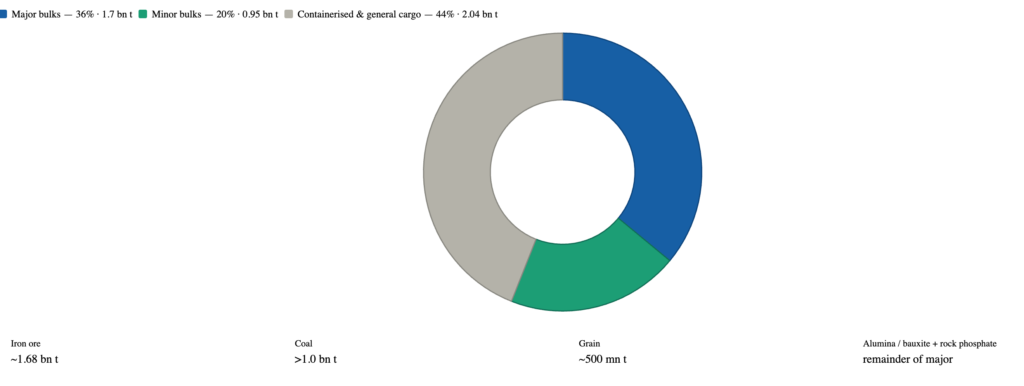
Pie chart showing global seaborne dry cargo composition: major bulks 36%, minor bulks 20%, containerised and general cargo 44%.
Iron Ore Shipping: Australia, Brazil, and the China Trade Route
No discussion of bulk terminals can begin anywhere other than iron ore the commodity that defines the entire architecture of the modern bulk shipping industry. The scale of growth since the early 2000s is almost incomprehensible.
Port Hedland and the Pilbara: World’s Largest Bulk Export Port
The Pilbara Ports region of Australia exported a record 758.3 million tonnes of iron ore in the 2023 financial year the fifth consecutive year of record throughput. Port Hedland alone contributed 573.6 million tonnes, valued at an estimated A$173.2 billion. China’s seaborne iron ore imports hit a record 1.2 billion tonnes in 2024 more than the entire world’s annual iron ore production in the early 2000s.
“The trade route from Australia and Brazil to China is essentially the spine of the world’s industrial metabolism.”
Engineering Imperatives at High-Volume Iron Ore Terminals
This concentration of trade flows explains why the Capesize vessel operating at 80,000 DWT and above accounts for over 70% of iron ore liftings, with Very Large Ore Carriers (VLOCs) taking another 20%. Port Hedland must handle:
| PORT HEDLAND OPERATIONAL SCALE 1. 240 wagons: continuous train arrivals from Rio Tinto, BHP, and Fortescue’s Pilbara operations 2. 10,000+ tonnes/hour: offloading rates at peak throughput 3. Stockpile yards measured in square kilometres 4. ~19 metres: maximum Capesize vessel loading draft 5. ChinaMax vessels up to 400,000 DWT: China’s Caofeidian and Qingdao terminals now accommodate these mega-ships |
The engineering logic behind larger vessels is straightforward: greater vessel size reduces unit transportation cost on long-haul routes, directly affecting the geographic competitive dynamics between Australian and Brazilian supply to Chinese ports.
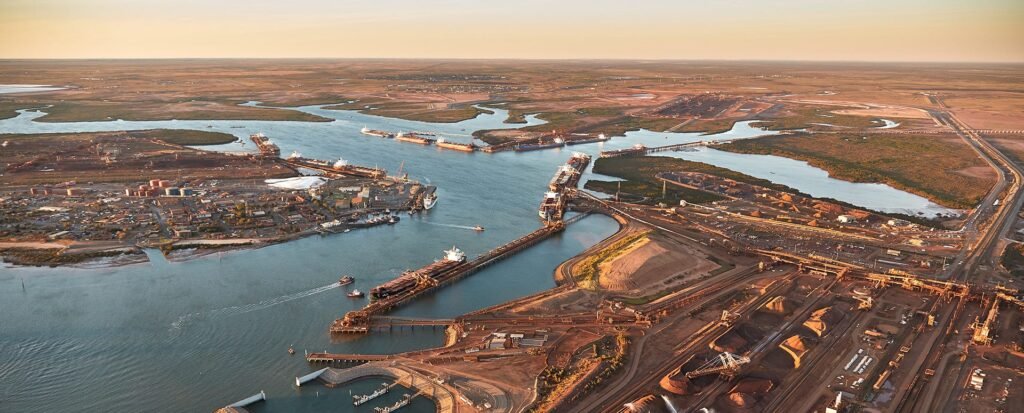
The Pilbara Ports region of Australia exported a record 758.3 million tonnes of iron ore in the 2023‚financial year, the fifth consecutive year of record throughput. Port Hedland alone contributed 573.6 million tonnes, valued at an estimated A$173.2 billion.
Coal Export Terminals: Indonesia, India, and the Energy Paradox
Indonesia: The World’s Largest Thermal Coal Exporter
Indonesia produced 830.96 million tonnes of coal in 2024, exceeding its own ambitious government target of 710 million tonnes by 17%. Of that total, 433.17 million tonnes were exported the largest coal export programme in the world delivered primarily to India, China, Japan, South Korea, and Vietnam.
Coal is extracted from mines in East and South Kalimantan, barged down river systems to coastal anchorages, transshipped onto ocean-going Panamax and Capesize vessels via floating logistics ecosystems operating in the Java Sea. Companies like Adaro Logistics operate fleets of over 54 barges and 60 tugs, with transshipment facilities processing 222,000 tonnes per day.
India’s Coal Import Infrastructure and Port Expansion
India the world’s second-largest coal importer at 236.5 million tonnes in 2024 operates dedicated coal terminals including Ennore (Chennai), Paradip, and Vizag on the east coast. India’s steel production grew to 136.29 million tonnes in FY2023–24, driving simultaneous growth in both coking coal imports and iron ore trade.
| VADHAVAN PORT PROJECT — INDIA’S NEXT SCALE LEAP 1. Announced in June 2024 by the Indian government 2. 298 million metric tonnes of annual handling capacity targeted 3. A single facility that would rank among the world’s largest ports when complete |
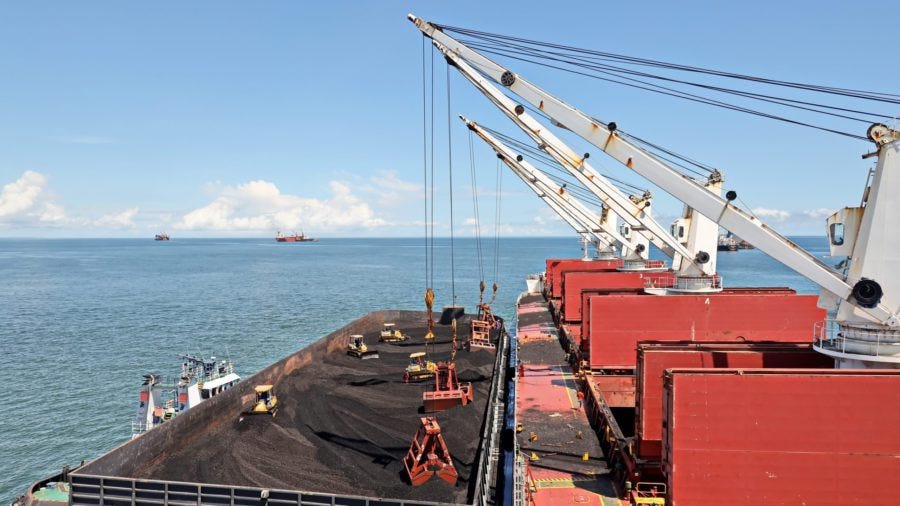
Coal barging operations, Kalimantan, Indonesia
How Dry Bulk Terminals Work: Anatomy of a Bulk Cargo Facility
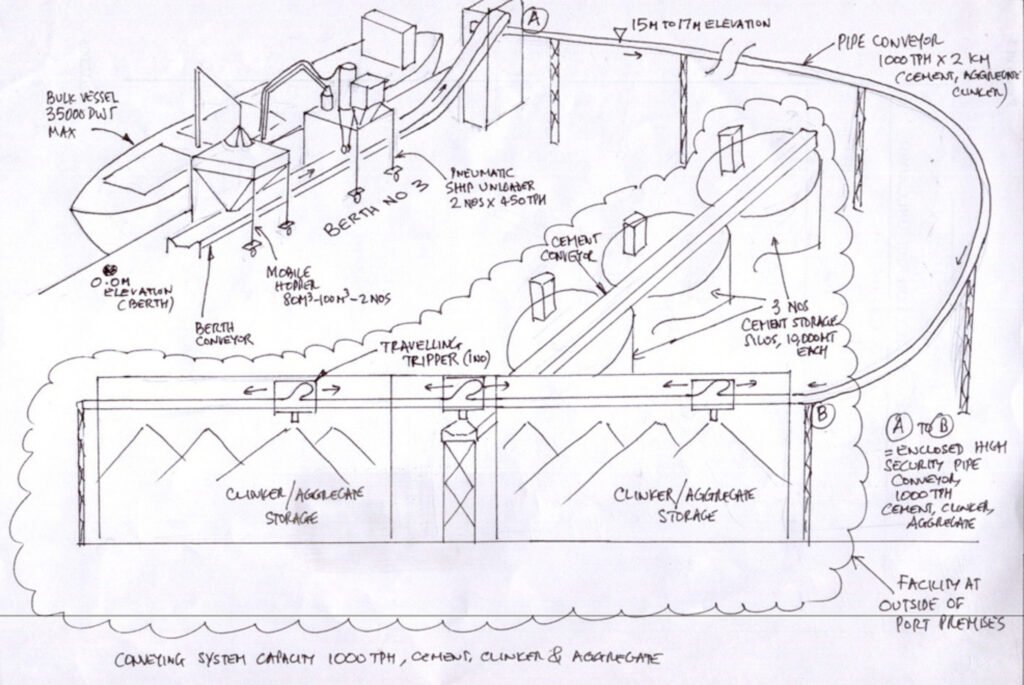
A dry bulk terminal is not simply a port. It is product-specific, purpose-built, and optimised for one material, one throughput range, one vessel type. A well-designed terminal integrates ship unloading, mechanical or pneumatic transfer, covered or open-air storage, and distribution infrastructure each element engineered to the specific commodity’s bulk density, flow characteristics, and environmental sensitivity.
The Operational Flow: Unloading and Loading Sequences
| STANDARD UNLOADING FLOW Ship arrives → material unloaded via grab crane, pneumatic unloader, or screw unloader Transfer to storage (flat store, silo, or dome) Material reclaimed → distributed by road, rail, or barge |
| STANDARD LOADING FLOW Material consolidated at storage facility Stacked and reclaimed via belt conveyors and stackers Loaded onto vessel, truck, or barge |
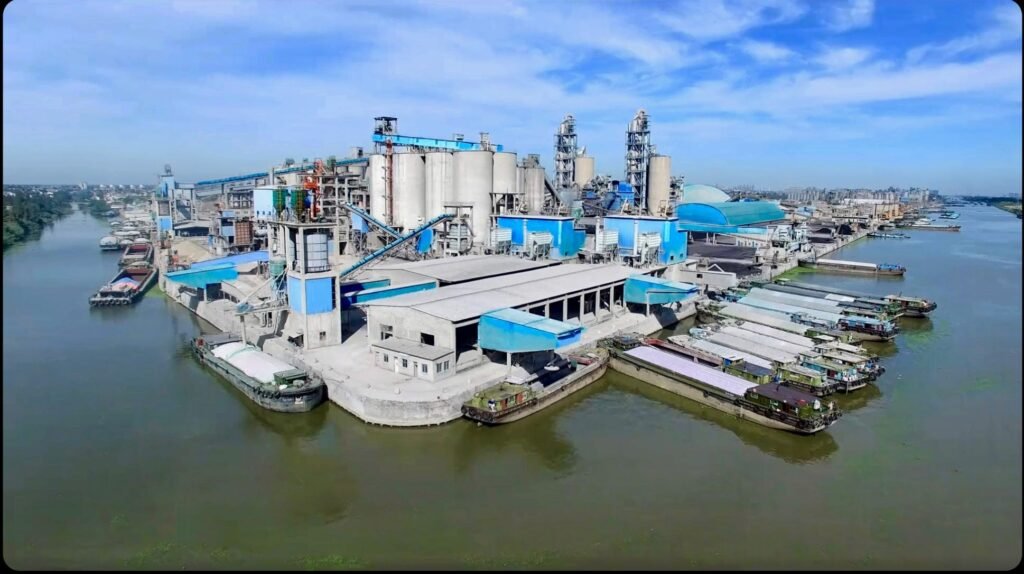
A well-designed bulk terminal integrates ship unloading, mechanical or pneumatic transfer, covered or open-air storage, and distribution infrastructure. Each element must be engineered to the specific commodity’s bulk density, flow characteristics, and environmental sensitivity.
The Dual Mandate: Maximum Performance, Minimum Impact
Every terminal owner faces the dual mandate two sets of objectives in constant tension. Optimizing both simultaneously is the central engineering challenge of the profession:
| MAXIMISE Throughput & income Productivity Operational safety Reliability Flexibility | MINIMISE Environmental pollution Capital investment Manpower requirements Vessel turnaround time Downtime |
Global Dry Bulk Fleet: Vessel Types and Cargo Capacities
The global dry bulk fleet tells the story of scale. As of 2024, the active fleet comprised approximately 17,500 ships, having grown 3.1% over the previous year. Each vessel class is optimised for specific trade routes and commodity types:
| Vessel Class | DWT Range | 2024 Volume | Primary Commodities |
| Capesize | 80,000+ DWT | ~70% of iron ore liftings | Iron ore, coal; Australia/Brazil–China routes |
| Panamax | 50,000–79,999 DWT | 250M+ tonnes | Grain, thermal coal; major and minor bulk routes |
| Handymax | 40,000–59,999 DWT | ~180M tonnes | Bauxite, nickel, fertilisers; medium-sized cargoes |
| Handysize | 10,000–39,999 DWT | 120M+ tonnes | Cement, scrap, minor minerals; draft-restricted ports |
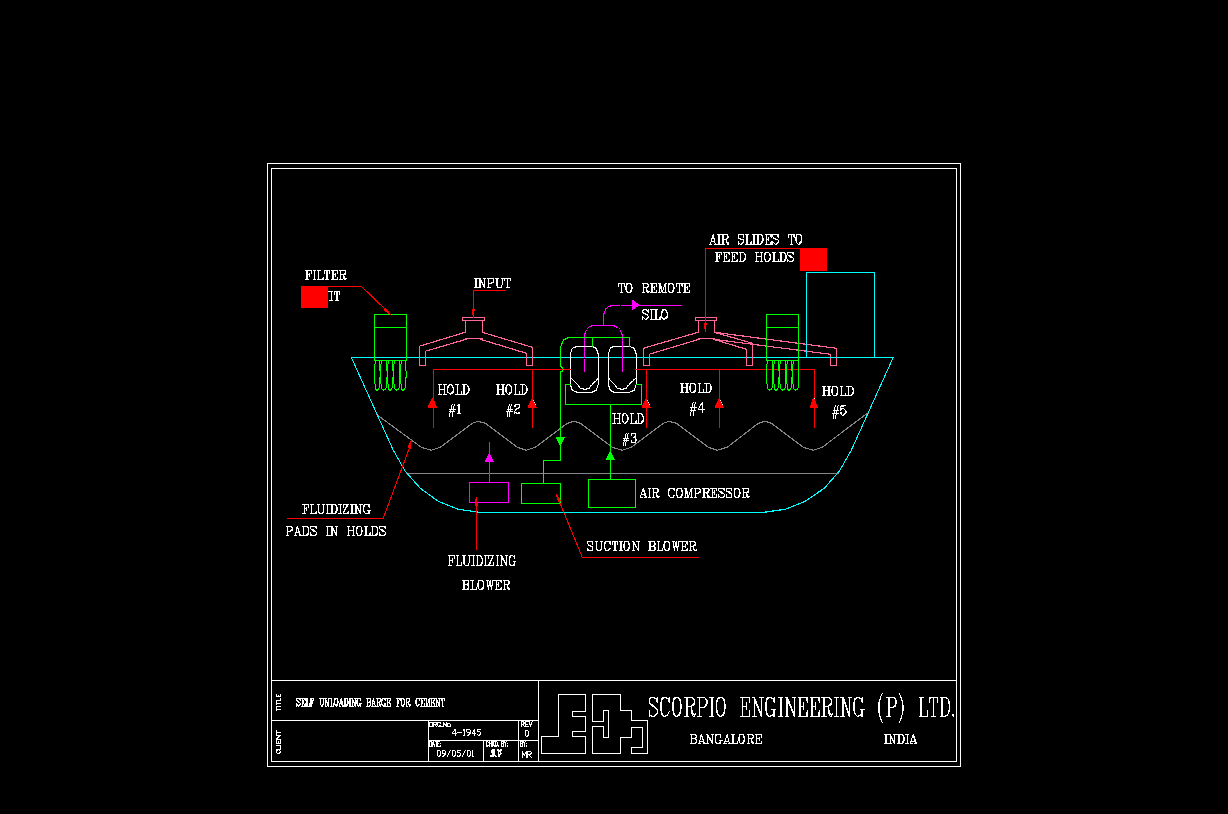
| Self-Unloading Barge | 2,500–10,000 DWT | Growing rapidly | Cement, aggregates; river systems, no fixed shore infrastructure |
Self-Unloading Vessels: Transforming Cement and Aggregate Distribution
The emergence of the self-unloading vessel equipped with its own onboard conveyor and discharge boom system has transformed the economics of cement and aggregate distribution. Self-unloading barges from 2,500 to 10,000 DWT allow cement to be discharged, directly into flat storage without fixed shore-side unloading infrastructure, dramatically reducing the capital required for a receiving terminal and enabling cement distribution up navigable river systems across Southeast Asia and India.
Dry Bulk Terminals as Civilisational Infrastructure
In India alone, the bulk materials sector handles an estimated 6.2 million individual 50 kg bags per day across cement, sugar, and soda ash production. Every bag filled is a fraction of a house being built, a sweetener reaching a family’s table, a soap reaching a bathroom.
“The optimum design and operation of a dry bulk terminal is not a technical exercise. It is an act of industrial responsibility.”
The engineering decisions made at these terminals vessel size specifications, storage typology, transfer system selection, environmental containment, maintenance philosophy have consequences that ripple across supply chains, national energy security strategies, and the food security of nations.
Frequently Asked Questions:
What is a dry bulk terminal and how does it differ from a container terminal?A dry bulk terminal is a port facility specifically designed to handle loose, unpackaged solid commodities such as iron ore, coal, grain, cement, and fertilisers that are loaded and discharged without individual packaging.
Unlike a container terminal, which handles standardised steel boxes of predictable dimensions and weight, a dry bulk terminal must be engineered around each commodity’s bulk density, flow characteristics, moisture sensitivity, and environmental risk profile.
Dry bulk terminals typically use grab cranes, pneumatic unloaders, or screw conveyors for ship discharge and store materials in open-air stockyards, covered flat stores, or enclosed silos depending on the commodity.
The five major dry bulk commodities often referred to as the ‘Big Five’are iron ore, coal (thermal and coking), grain (wheat, corn, soybeans), bauxite and alumina, and rock phosphate.
Together, these five commodities account for approximately 1.7 billion tonnes of annual seaborne trade, representing around 36% of all dry cargo volumes by weight.
Beyond these majors, the ‘minor bulks’ fertilisers, sugar, cement, steel products, and forest products collectively add another 950 million tonnes per year.
China’s extraordinary industrial scale makes it the single largest importer of dry bulk commodities in the world. In 2024, China’s seaborne iron ore imports alone reached a record 1.2 billion tonnes more than the entire world’s iron ore production in the early 2000s.
This demand has driven the growth of the Capesize and VLOC fleet, shaped port infrastructure investments across Australia and Brazil, and led China to develop mega-terminals at ports like Caofeidian and Qingdao capable of accommodating ChinaMax vessels of up to 400,000 DWT.
Capesize vessels (80,000 DWT+) are too large to transit the Panama or Suez Canals at full load they route around the Cape of Good Hope and dominate iron ore and coal trades on long-haul routes between Australia/Brazil and China.
Panamax vessels (50,000–79,999 DWT) were sized to fit through the original Panama Canal locks and are workhorses of the grain and thermal coal trades.
Handymax and Handysize vessels (10,000–49,999 DWT) serve smaller ports with draft restrictions and are widely used for minor bulks including cement, fertilisers, bauxite, and scrap metal.
The dry bulk shipping market was valued at approximately $168.5 billion in 2025, growing at a compound annual rate of over 4%, and is projected to reach close to $250 billion by 2035.
The active global dry bulk fleet comprised approximately 17,500 ships as of 2024, having grown 3.1% year-on-year. Growth in fleet capacity continues to be matched by investment in port infrastructure, particularly in China and India.
Indonesia produced 830.96 million tonnes of coal in 2024 and exported 433.17 million tonnes more than any other nation. Its dominance is explained by large and geologically accessible coal reserves in East and South Kalimantan, low extraction and transport costs via extensive river barge logistics, and proximity to the major thermal coal import markets of India, China, Japan, South Korea, and Vietnam.
Companies like Adaro Logistics operate large integrated barge and tug fleets capable of processing over 220,000 tonnes of coal per day through their floating transshipment systems in the Java Sea.
Is Your Terminal Losing
Throughput to Inefficient Powder Handling?
Get a complimentary engineering consultation
from Scorpio BMH — specialists in pneumatic conveying for bulk terminals since
1984.
TRUSTED BY OVER 1,226 CLIENTS WORLDWIDE — INCLUDING:
BASF · Air Liquide · Asahi India Glass · Bhabha Atomic Research Centre · Brakes India · Cadbury India · Crown Cement