
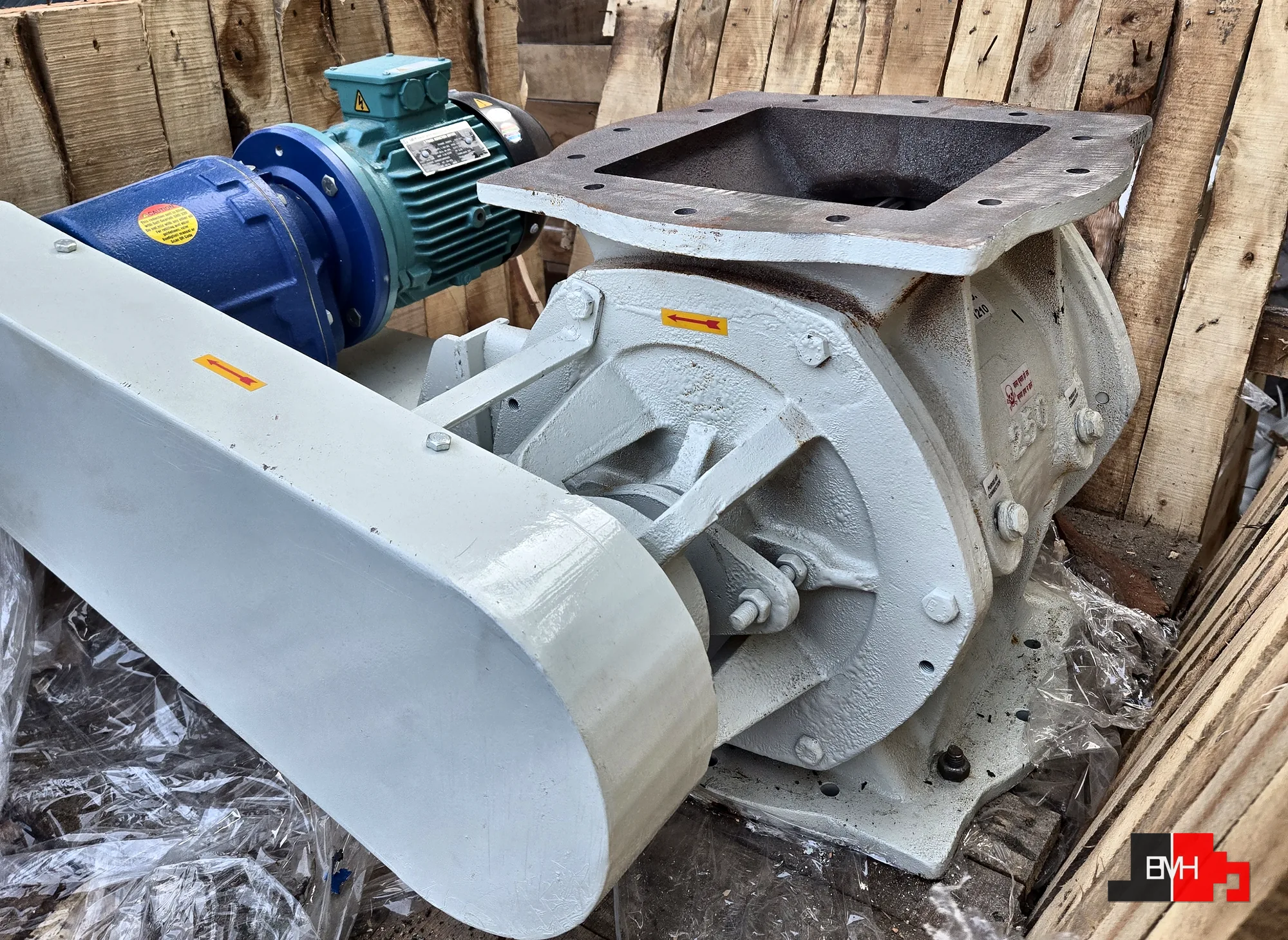
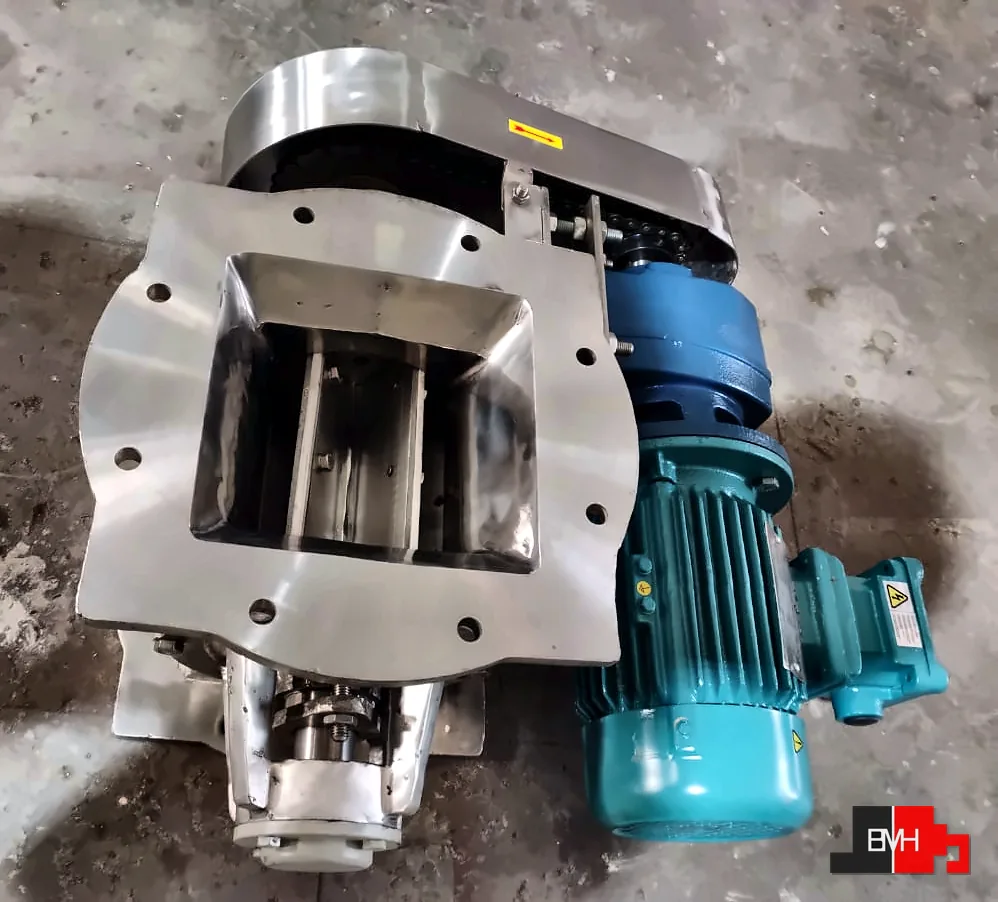
A rotary airlock valve feeds dry bulk material at a controlled rate from a bin, hopper or silo into a pneumatic conveying line, or onward by gravity. Its job is to let material through while stopping conveying air from leaking back into the vessel above. Scorpio builds heavy-duty rotary airlocks from 150 mm to 500 mm in Bangalore, as standalone valves or as part of a complete conveying system.
Drop-through — material falls through the rotor into the line or chute below. The standard choice for feeding under bins and hoppers.
Blow-through — conveying air passes through the rotor pockets and sweeps them clean. Suited to sticky or cohesive powders that would otherwise build up in the pockets.
Pellet design — rotor and inlet geometry that reduce shearing of plastic pellets and granules at the inlet.
Quick-clean design — for frequent product changes or hygienic duties, where the rotor needs to come out for cleaning without long downtime.
| Sizes | 150, 200, 250, 300, 350, 400, 450 and 500 mm diameter |
|---|---|
| Types | Drop-through · blow-through · pellet · quick-clean |
| Rotor | Open-ended, closed-ended or pocket type |
| Vane tips | Adjustable; hardened tips optional for abrasive duty |
| Bearings | Outboard, kept out of the product stream |
| Shaft sealing | PTFE or Inmarco |
| Air purge | Provision included |
| Material of construction | MS construction · SS304 contact parts · PTFE coated |
| Paint | Synthetic enamel, 100 DFT (epoxy optional) |
| Drive | Geared motor, chain drive or direct mounted |
Most rotary airlocks Scorpio supplies feed a conveying line: under a silo or day bin into a dilute phase pneumatic conveying system, or at the discharge of a filter receiver at the end of a vacuum line. Downstream, a multiway diverter or heavy-duty diverter sends the material to the right destination. For abrasive or fragile materials where a low-velocity system is the better fit, see dense phase pneumatic conveying.
Scorpio supplies the airlock alone for a retrofit or replacement, or sizes it as part of a turnkey conveying system.
1: What does a rotary airlock valve do?
It feeds dry bulk material at a controlled rate from a bin, hopper or silo into a pneumatic conveying line or a gravity chute, while limiting air leakage between the conveying line and the vessel above.
2: What is the difference between a drop-through and a blow-through rotary valve?
In a drop-through valve, material falls out of the rotor pockets into the line below. In a blow-through valve, the conveying air passes through the rotor and sweeps the pockets clean, which suits sticky or cohesive powders.
3: What sizes of rotary airlock valve does Scorpio make?
Scorpio manufactures rotary airlock valves from 150 mm to 500 mm diameter, in MS construction with SS304 contact parts or PTFE coating.
4: Can a rotary airlock handle abrasive powders?
Yes. For abrasive duty Scorpio fits hardened vane tips, which are adjustable so clearances can be restored as they wear.
5: Where are Scorpio rotary airlock valves made?
In Bangalore, India, by Scorpio Engineering BMH, which has built pneumatic conveying systems and components since 1984.